
The short answer is that more study is needed to determine a definitive answer. There are multiple forms of CoQ10, including the oxidized form and the reduced form.
- Oxidized CoQ10: Ubiquinone (typical form)
- Reduced CoQ10: Ubiquinol
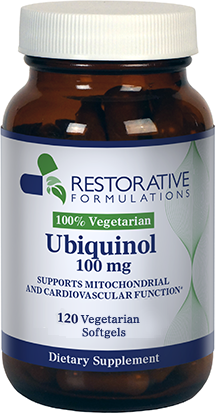
While CoQ10 has been available as a supplement for a long time, recently, ubiquinol has become a popular form for sale. There has been much debate as to which form is most bioavailable in humans, since ubiquinone is converted to ubiquinol in vivo.
Supplement companies have conducted studies using different forms of CoQ10 – such as powder or soluble form. They have also conducted dose/pharmacokinetic studies, including single dose vs chronic dose. These have been performed by supplement companies.1 This study is likely the best study for determining ideal doses and administration of ubiqinone (CoQ10).
Probably the best evidence that there is a difference between these supplements comes from a study of 12 participants, sponsored by company that sell ubiquinol, suggests that Ubiquinol is more bioavailable.2
Another study conducted by a pharmaceutical company also concluded that a reduced form of CoQ10 (CoQ10-CF) is more bioavailable.3 This supports the study above, although the study does not specify whether the reduced form of CoQ10 that they used is ubiquinol (trade secret).
However, because these studies were conducted by the companies that manufacture the Ubiquinol, it’s important to determine whether a clinical study has been conducted with less bias. Unfortunately, it doesn’t appear that such a study exists. There are hundreds of quasi-experimental or clinical trials that have been conducted with either ubiquinone or ubiquinol, however the only comparative studies are the two above. In addition, while the company funded projects demonstrate more CoQ10 in the blood, they don’t demonstrate clinical benefit. Thus, more research is needed.
Steven Sinatra, MD has found no benefit from ubiquinol in his clinical cardiology research and only recommends ubiquinone.
- Bhagavan HN, Chopra RK. Plasma coenzyme Q10 response to oral ingestion of coenzyme Q10 formulations. Mitochondrion. 2007; 7:S78-S88. doi:10.1016/j.mito.2007.03.003
- Langsjoen PH, Langsjoen AM. Comparison study of plasma coenzyme Q10 levels in healthy subjects supplemented with ubiquinol versus ubiquinone. Clin Pharmacol Drug Dev. 2014; 3(1):13-17. doi:10.1002/cpdd.73
- Evans M, Baisley J, Barss S, Guthrie N. A randomized, double-blind trial on the bioavailability of two CoQ10 formulations. J Funct Foods. 2009; 1(1):65-73. doi:10.1016/j.jff.2008.09.010