
Your Gut Is the Foundation of Your Health
Inside your body lives a vast community of trillions of microorganisms—bacteria, fungi, and other microbes—collectively known as the microbiome. This inner ecosystem plays a central role in digestion, immune defense, mood, energy, and overall wellness. When the balance of this microbial community is disrupted—by stress, poor diet, antibiotics, or illness—it can affect how you feel from head to toe.
The good news? You can support a healthy microbiome through three powerful, interconnected tools: prebiotics, probiotics, and postbiotics.
Prebiotics: Food for Your Good Bacteria
Prebiotics are specialized fibers—such as inulin and fructooligosaccharides—that serve as nourishment for beneficial gut bacteria. They help support microbial diversity, promote regularity, and encourage the production of beneficial compounds in the gut. Think of them as fertilizer for your inner garden.
Probiotics: Reinforcing the Good Guys
Probiotics are live beneficial bacteria that, when taken in adequate amounts, support a healthy microbial balance. Well-researched strains like Lactobacillus acidophilus DDS-1, Bifidobacterium animalis subsp. lactis HN019, and Lactobacillus rhamnosus GG (LGG) have been clinically studied to support:
- Healthy digestion and bowel regularity
- Normal immune function
- A healthy gut lining
- Mood and cognitive wellness through the gut-brain connection
Using a broad-spectrum, multi-strain probiotic formula is important because different strains support different systems in the body. A diverse blend more closely mirrors the natural complexity of a healthy gut microbiome and may offer broader benefits than any single strain alone.
Postbiotics: The Next Frontier in Microbiome Support
While probiotics get most of the attention, postbiotics are quickly emerging as one of the most exciting advances in gut health.
Postbiotics are the beneficial byproducts produced when probiotic bacteria ferment and do their work. They include short-chain fatty acids (like butyrate), cell wall fragments, and natural antimicrobial compounds called bacteriocins. Unlike live probiotics, postbiotics don’t need to survive the journey through your digestive tract to be effective- they’re already in their active, bioavailable form.
This makes postbiotics uniquely powerful. Here’s why they matter:
- Stable and reliable: Postbiotics are heat-stable, require no refrigeration, and deliver consistent benefits regardless of your individual gut composition.
- Gut barrier support: Compounds like butyrate help support the integrity of the gut lining, which is central to digestive and immune health.*
- Immune modulation: Postbiotics interact directly with immune cells in the gut, helping to support a balanced immune response.*
- Gut-brain wellness: Certain postbiotic metabolites support the production of neurotransmitters like serotonin and GABA, promoting a calm, balanced mood.*
- Metabolic support: Short-chain fatty acid postbiotics help support healthy blood sugar metabolism and appetite regulation.*
- Natural antimicrobial activity: Bacteriocins produced by strains like Pediococcus acidilactici UL5 help create a less hospitable environment for unwanted organisms.*
- Broad safety profile: Because postbiotics are non-living, they are well-suited for sensitive populations, including the elderly and those with compromised immune systems.*
The Power of the Trio in Microbiome Synergy
Prebiotics, probiotics, and postbiotics work best together, that’s why we formulated Microbiome Synergy to harness this powerful trio. Prebiotics nourish beneficial bacteria, probiotics help restore and maintain microbial balance, and postbiotics deliver targeted, reliable support at the cellular level.
What to Look for in a Quality Formula
Not all probiotic and postbiotic supplements are created equal. Look for products that feature clinically studied strains at meaningful doses, transparent labeling with strain identity and potency, broad-spectrum diversity, and appropriate storage guidance. The best formulas are designed with both efficacy and safety in mind—and supported by real research.
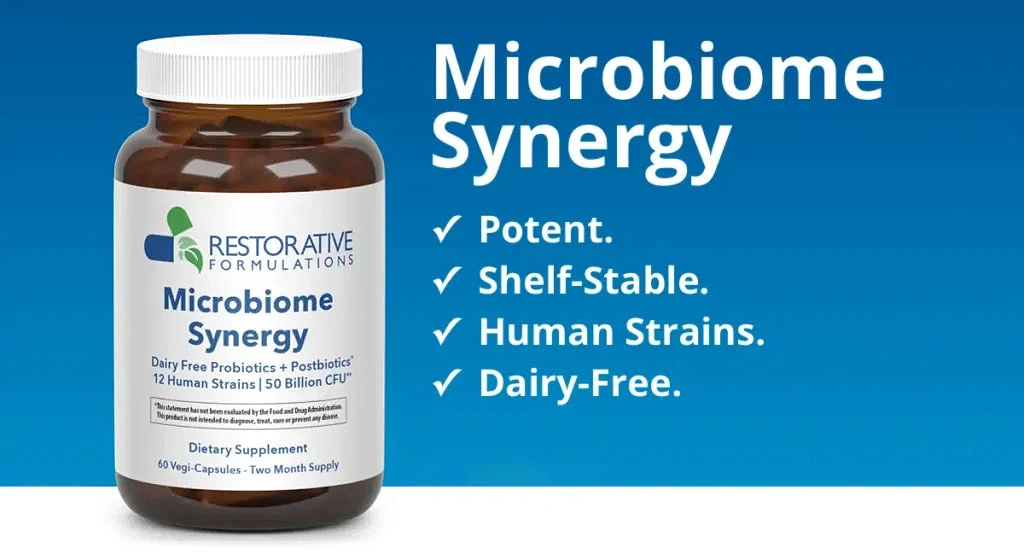
Microbiome Synergy contains twelve well-researched human strains of dairy-free probiotics and postbiotics to that work synergistically to support a healthy and balanced microbiome.
Each shelf-stable capsule contains a minimum of 50 billion CFU per vegi capsule by the time of expiration-meaning, we start with much more!
References
Gill HS, et al. Enhancement of immunity in the elderly by dietary supplementation with the probiotic Bifidobacterium lactis HN019. Am J Clin Nutr. 2001;74(6):833-839.
Gomes AC, et al. Gut microbiota is associated with adiposity markers and probiotics may impact specific genera. Eur J Nutr. 2020;59(4):1751-1762.
Ibarra A, et al. Effects of 28-day Bifidobacterium animalis subsp. lactis HN019 supplementation on colonic transit time and gastrointestinal symptoms in adults with functional constipation. Gut Microbes. 2018;9(3):236-251.
Ouwehand AC, Salminen S, Isolauri E. Probiotics: an overview of beneficial effects. Antonie van Leeuwenhoek. 2002;82(1-4):279-289.
Pärtty A, et al. A possible link between early probiotic intervention and the risk of neuropsychiatric disorders later in childhood: a randomized trial. Pediatr Res. 2015;77(6):823-828.
Plaza-Diaz J, et al. Mechanisms of action of probiotics. Advances in Nutrition. 2019;10(suppl_1):S49-S66.
Sanders ME, et al. Shared mechanisms among probiotic taxa: implications for general probiotic claims. Curr Opin Biotechnol. 2018;49:207-216.
Silva CCG, et al. Application of Bacteriocins and Protective Cultures in Dairy Food Preservation. Front Microbiol. 2018;9:594.
Simon M, et al. Modifiable Risk Factors for SARS-CoV-2. Integr Med (Encinitas). 2021;20(5):8-14.
Suez J, et al. The pros, cons, and many unknowns of probiotics. Nature Medicine. 2019;25(5):716-729.
Turner et al. Effect of probiotic on innate inflammatory response and viral shedding in experimental rhinovirus infection. Beneficial Microbes. 2017;8(2):207-215.
West NP et al. Probiotic supplementation for respiratory and gastrointestinal illness symptoms in healthy physically active individuals. Clinical Nutrition. 2014;33(4):581-7.